Can your electrical panel handle an EV charger?
It depends on how much power your house already uses. I'm Jason, an electrician. I built ChargeRight to work that out for your house and put it in writing before you pay for a new panel.
- Pick your car
- Snap your panel
- Get a professional report
$49.99 one-time · 30-day money-back · electricians charge $150 to $300 for this calc
Not ready to pay? Run the free 60-second panel check, no signup.
- Built by an electrician
- NEC Article 220 residential load calculation
- EVITP certified (EV Infrastructure Training Program)
- No upsell, ever. No referral fees
- Featured in Yahoo Finance
How it works
- 01
01Pick your car
Start with your EV. Its charger sets the load the math has to test.
- 02
02Snap your panel
Answer a few questions about your home. Add panel photos if you want the AI to read the details for you.
- 03
03Get your report
A plain-English verdict, the exact circuit size your car needs, the full NEC Article 220 math, and a bid checker for the quote you get. PDF included.
- Done in minutes
- AI-assisted photo analysis
- NEC Article 220 calculation
- Private. Photos are used only to analyze your panel
- Bid checker included. See whether the quote you got is fair
- 30-day money-back guarantee
What the $49.99 buys
One price, the whole answer. No subscription, no upsell:
- A plain-English verdict: can your panel take the charger, yes or no
- The full NEC Article 220 load report with every number behind it
- The exact circuit size your car needs
- A PDF ready to hand your electrician
$49.99 here|$150 to $300 on a service call|typically $2,000 to $4,500 if you get talked into the upgrade

Jason Walls, electrician. The same calc I run on a service call. My story|The method
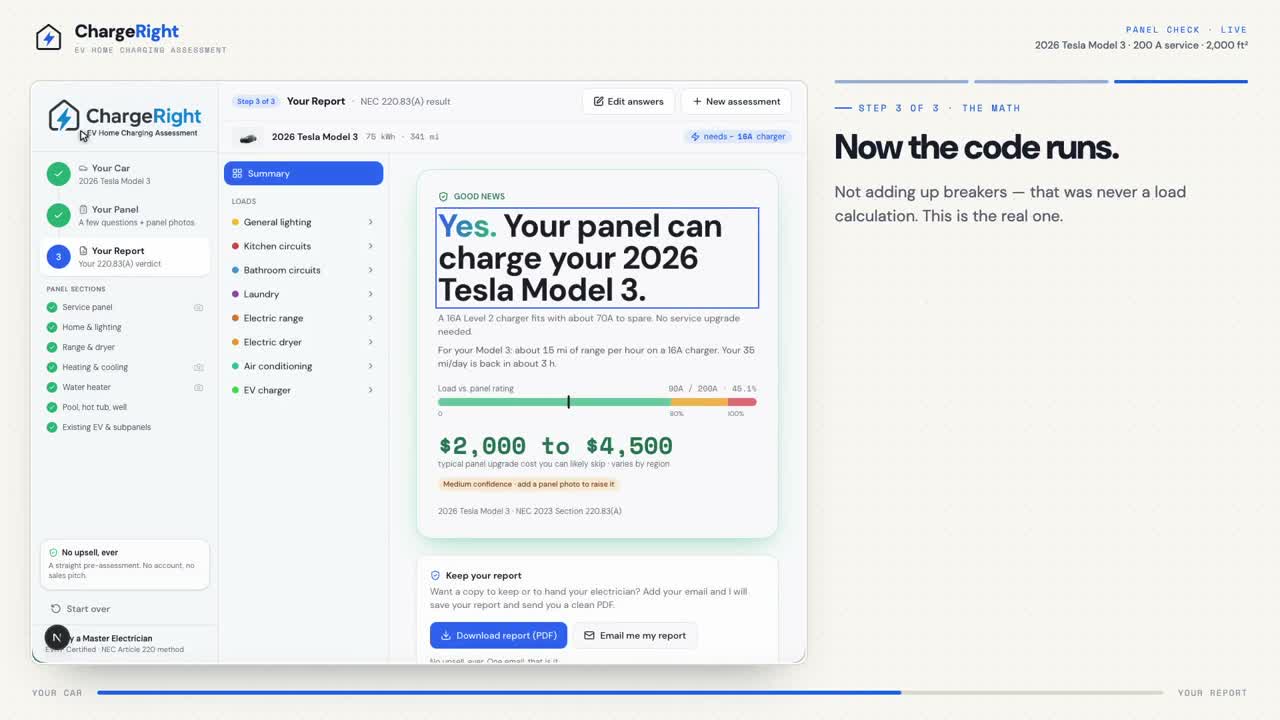
Good news
Yes. Your panel can charge your EV.
- General lighting
- Kitchen circuits
- Bathroom circuits
- Laundry
- EV charger
- The full NEC Article 220 math
Ask about a car charger, and the first answer you usually get is that you need a new panel. The electrical code's own math adds up what runs on it, like the AC, the dryer, the range and the water heater.
The NEC Article 220 math gives your home credit for how it actually runs, not the worst case your breaker ratings suggest. Like a CarFax for your electrical panel: know its true capacity before anyone bids an upgrade. Why upgrade quotes go wrong|How ChargeRight compares
What homeowners say
Real reviews from our Google Business Profile, quoted word for word.
"Phenomenal app. Makes figuring out what you need to do a breeze. Support is very responsive and helpful. Would highly recommend to anyone needing to install a charger."
"ChargeRight takes the guesswork out of trying to figure out if you truly need an electrical panel upgrade which can be extremely costly. … Jason’s report is extremely well done and professional. Very well done and easy to understand. … I highly recommend it to anyone planning a panel upgrade."
Straight answers
Do I need a panel upgrade for an EV charger?
Most homes do not. NEC 220.83(A), the load calculation written for an existing home adding a charger, gives credit for how your home actually runs, and a lot of panels have more room than the fast quote assumes. The check tells you whether yours does. If you have a year of utility peak-demand data, an electrician can also check the existing load under NEC 220.87.
What do I receive with the assessment?
A plain-English verdict on whether your panel can take the charger, the exact circuit size your car needs, and the full NEC Article 220 load report with every number behind it - ready to hand your electrician. PDF included.
Is this NEC compliant?
The report runs the NEC Article 220 load calculation that fits your situation. For an existing home adding a charger that is 220.83(A), the section the code wrote for exactly that case. It is the same math a licensed electrician puts on a permit drawing, and the report names the section that produced your verdict. It is a pre-assessment, not a permit or a final electrical design.
Is ChargeRight an electrical contractor or electrician service?
No. I do not bid, schedule, or sell installs, and no contractor pays to be recommended. This is the math, not a sales funnel. No upsell, ever.
How much does ChargeRight cost compared to an electrician?
The assessment is $49.99, one time, on evchargeright.com. No subscription. (Bought inside the iOS app, the same report is $69.99, because of Apple's commission.) The same calculation done in person typically runs $150 to $300 as a service call.
Will my house handle a Level 2 charger?
That is exactly the question the check answers. Pick your car, answer the panel questions, and you get an honest yes or no - with the numbers to back it.
Can my panel handle a Tesla Wall Connector?
On most 200-amp homes, yes. At its full 48 amps the Wall Connector adds 11,520 VA on a 60-amp circuit. Add that to your home's NEC 220.83(A) load and compare the total to your main breaker rating. If it is over, the charger can be set lower, such as 40 or 32 amps, before anyone talks about a panel upgrade. How to check your panel for a Wall Connector
Which NEC section applies to an existing home adding an EV charger?
Normally NEC 220.83(A), when no new heating or air conditioning goes in with the charger. It is the section the code provides for checking whether an existing service has capacity for additional loads. NEC 220.82 is normally used for new construction or a full service change, and 220.83(B) applies when new heating or air conditioning is added too. The NEC 220.83(A) calculation, worked line by line
Find out how much room your panel has left for a car charger.
Nobody has to come to your house. You answer a few questions about your home, add photos of your panel if you have them, and the answer comes back in minutes.
Secure checkout · 30-day money-back guarantee